Phobos and Deimos
Two small, lumpy moons named after the horses of a war god. One of them is on a very slow collision course.
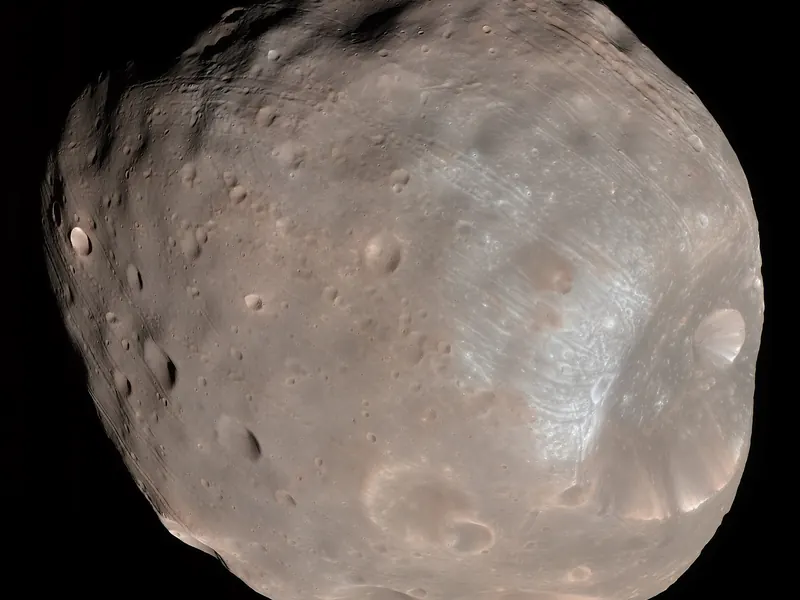
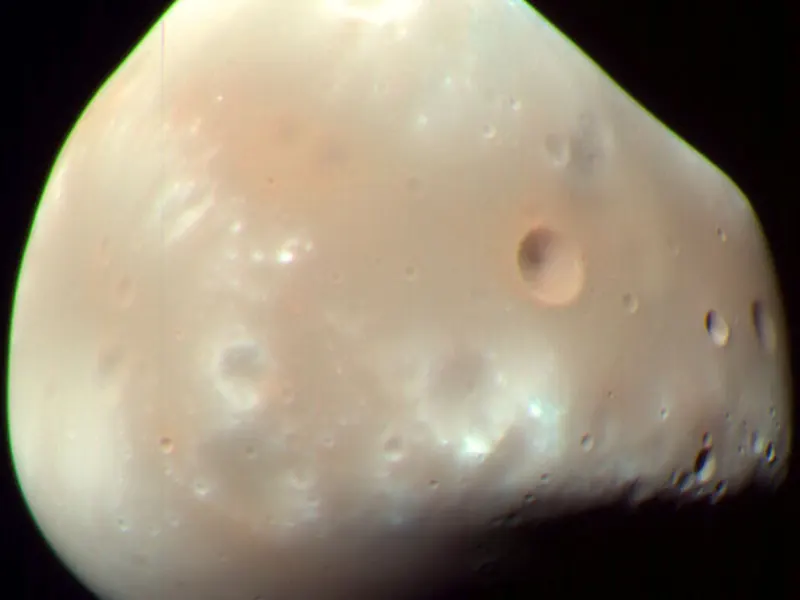
Two little moons
Mars has two small moons, Phobos and Deimos. NASA Science: Mars moons · checked 25 Oct 2026 Both moons are potato-shaped, because they have too little mass for gravity to pull them into balls. They may be captured asteroids. NASA Science: Mars facts
Asaph Hall discovered both moons in 1877. NASA Science: Phobos They are named after the horses that pulled the chariot of Ares, the Greek god of war. NASA Science: Mars facts
Phobos
Phobos, the larger moon, goes round Mars three times a day. NASA Science: Mars moons Phobos is only 27 by 22 by 18 km. NASA Science: Phobos
Phobos’s biggest crater, Stickney, is named after Chloe Angeline Stickney Hall, a mathematician and the wife of Asaph Hall. NASA Science: Phobos
Falling, very slowly
Phobos is creeping closer to Mars by 1.8 m every hundred years. In about 50 million years it will crash into Mars or break up into a ring. NASA Science: Mars moons
Deimos
Deimos, the smaller moon, is just 15 by 12 by 11 km and goes round Mars every 30 hours. NASA Science: Deimos Deimos looks smoother than Phobos because loose dirt fills many of its craters. NASA Science: Mars facts
And rings?
Mars has no rings. NASA Science: Mars facts
Not yet, anyway: see what might happen to Phobos, above.
Next: missions & rovers →