Things everybody “knows” about Mars
A face on a hill, a sky the wrong colour and a planet that looks hot but isn’t. Here they are, gently corrected.
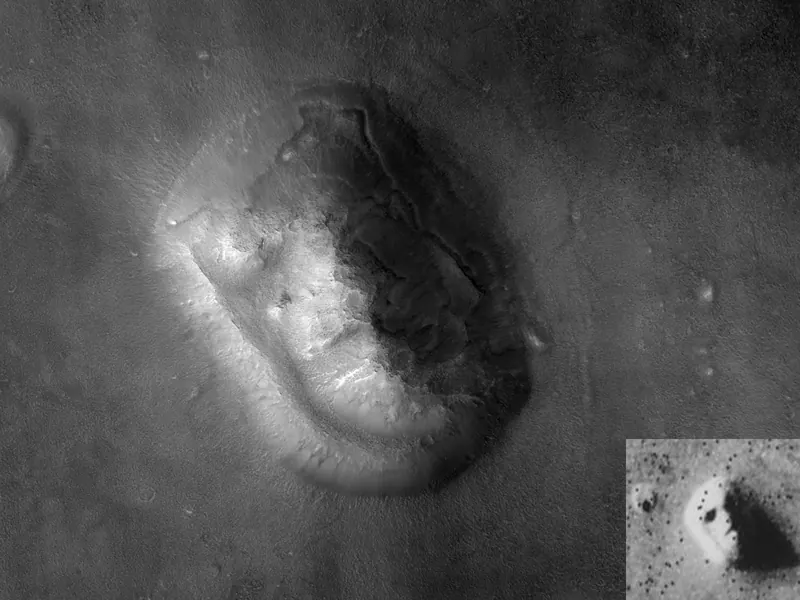
Myth There’s a giant carved face on Mars.
Fact In 1976 the Viking 1 orbiter photographed a hill that looked like a human face. NASA explained at the time that shadows gave the illusion of eyes, nose and mouth. NASA Science: The “Face on Mars” In 1998 Mars Global Surveyor photographed the “Face” again, ten times sharper than the best Viking picture. NASA Science: Face on Mars (1998 image)
Myth The sky on Mars is blue, like ours.
Fact To our eyes the Martian sky would look hazy and red, because of dust floating in the air, not blue like Earth’s. NASA Science: Mars facts
Myth Mars is the red planet, so it must be hot.
Fact The average temperature on Mars is about −59 °C. NASA NSSDC: Mars fact sheet Temperatures on Mars can reach 20 °C or drop to about −153 °C. NASA Science: Mars facts
Myth Mars is red because it’s covered in blood, or lava.
Fact It’s called the Red Planet because iron minerals in the Martian dirt oxidise, or rust. NASA Science: Mars facts The Red Planet is actually many colours. Up close the ground is brown, gold and tan. NASA Science: Mars facts
Myth There has never been any water on Mars.
Fact Mars has ancient river valleys, deltas and lakebeds, and rocks that could only have formed in liquid water. NASA Science: Mars facts There is water on Mars today, mostly as ice just under the surface near the poles. The air is too thin for liquid water to last long on the surface. NASA Science: Mars facts
Myth Mars is about the same size as Earth.
Fact With a radius of 3,390 km, Mars is about half the size of Earth. NASA Science: Mars facts If Earth were the size of a nickel (a US 5-cent coin), Mars would be about as big as a raspberry. NASA Science: Mars facts
Myth Mars has rings, like Saturn.
Fact Mars has no rings. NASA Science: Mars facts Phobos is creeping closer to Mars by 1.8 m every hundred years. In about 50 million years it will crash into Mars or break up into a ring. NASA Science: Mars moons
Myth Nobody has ever flown anything on Mars.
Fact On 19 April 2021 the Ingenuity helicopter made the first powered, controlled flight on another planet. NASA Science: Ingenuity Mars Helicopter